News
Suspended Dump Body: What a Spider Web Teaches Mining
October 21, 2026
A Suspended Dump Body solves a problem that spiders solved millions of years ago: how to stop a fast-moving load without destroying the structure that catches it.
On a mine site, haul trucks take thousands of tonnes of rock dropped from height every shift. How the body handles that impact decides how much vibration, noise and fatigue the operator and the truck absorb. Nature offers a surprisingly good blueprint.

How a Spider Web Absorbs Impact
A Suspended Dump Body solves a problem that spiders solved millions of years ago: how to stop a fast-moving load without destroying the structure that catches it.
On a mine site, haul trucks take thousands of tonnes of rock dropped from height every shift. How the body handles that impact decides how much vibration, noise and fatigue the operator and the truck absorb. Nature offers a surprisingly good blueprint.

The Spider Web Absorbs Impact & Dissipates the Energy
An orb web must stop flying prey without breaking, and survive wind and rain, using almost no material. A rigid panel takes an impact as a sharp spike of force and cracks. A web gives way instead.
A 2020 finite-element study of spider web structures found that a web can absorb the kinetic energy of an impact and dissipate about 70% of the converted energy. Laser-vibrometer measurements of real webs add another detail. The spiral threads have high damping, and they spread vibration into the stronger radial threads that carry the load to the frame. One part absorbs, and another part carries
The Physics: Tension, Strain Energy and Damping
Three principles explain why the web works:
Tension:
Every thread is under tension, a principle engineers call tensegrity. The structure stays light, and the load is shared across the whole network.
Strain-energy absorption:
Stretching threads store and dissipate energy. A longer stopping distance means a lower peak force, which is why catching a ball with a soft hand hurts less than with a stiff one.
Damping:
After the hit, vibration dies away quickly. A structure that keeps ringing, like a steel plate struck by a rock, keeps passing energy on as noise and fatigue.
Why a Rigid Steel Tray Does the Opposite
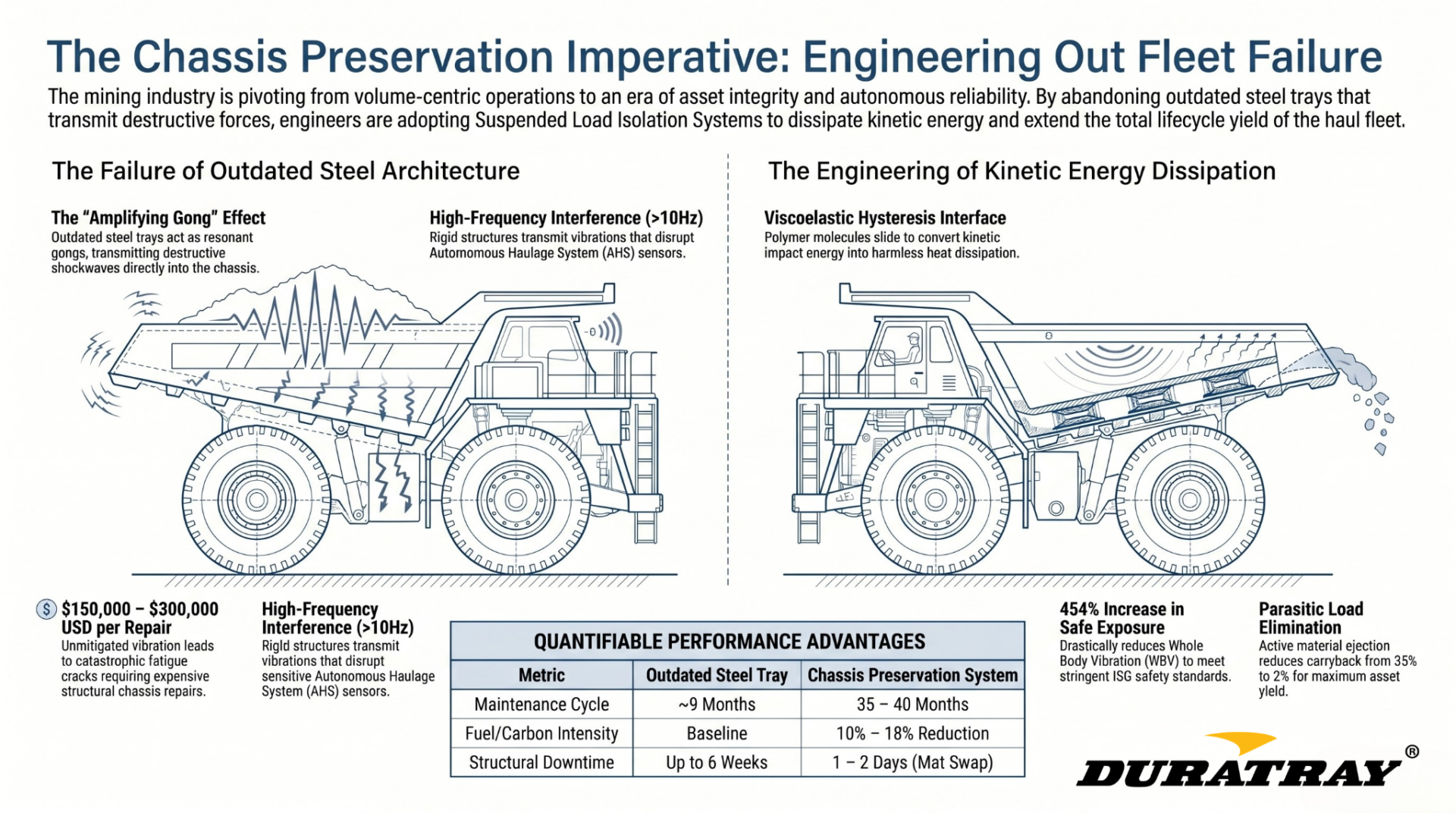
A conventional steel tray is fixed to the chassis and built to resist. Each time a loader drops rock into it, the impact travels through the steel, into the chassis, up through the cab and into the operator’s body.
Stiffness is right for a hammer, which must deliver impact. It is wrong for a body that must receive impact all day.
How the Suspended Dump Body Applies the Same Principle
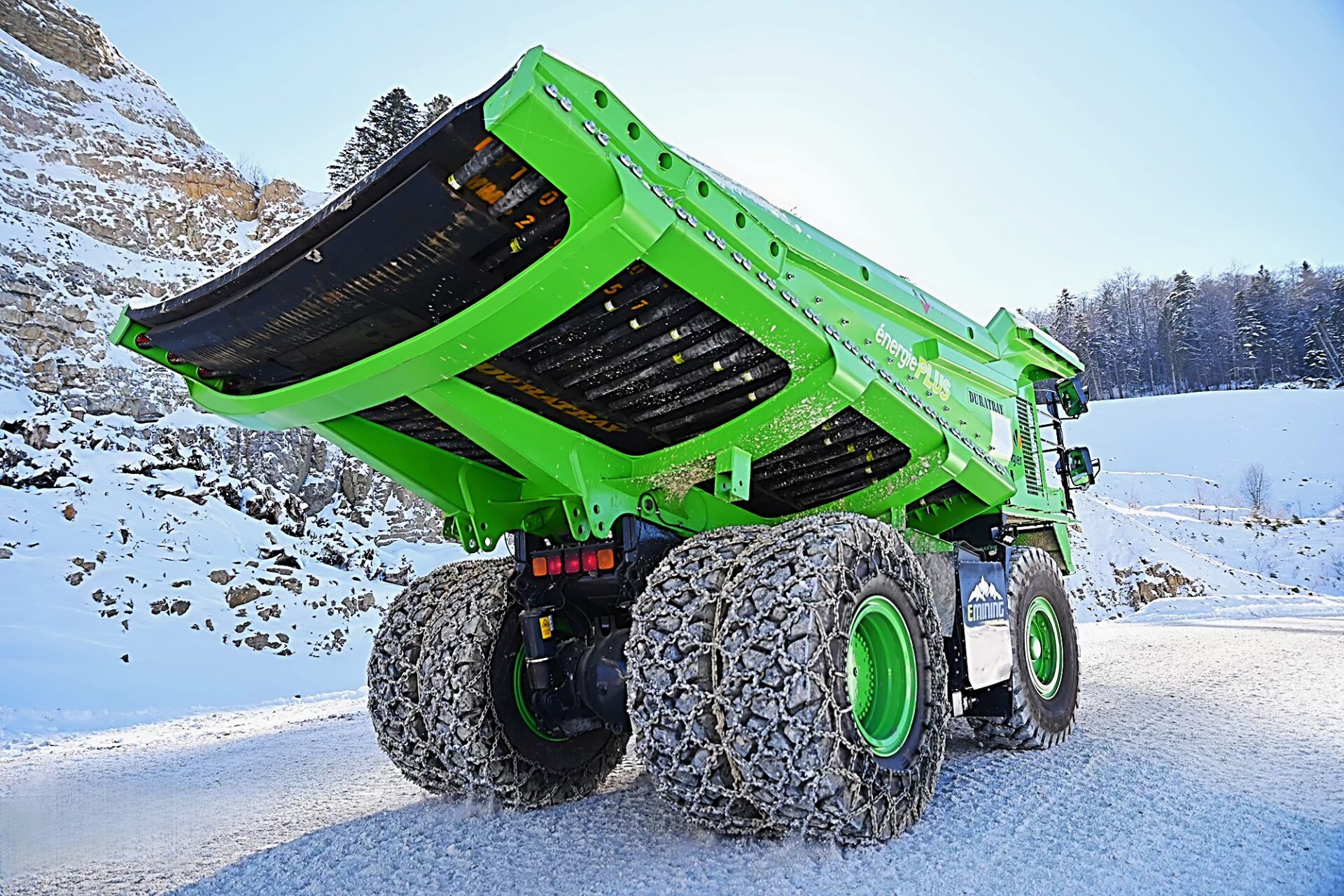
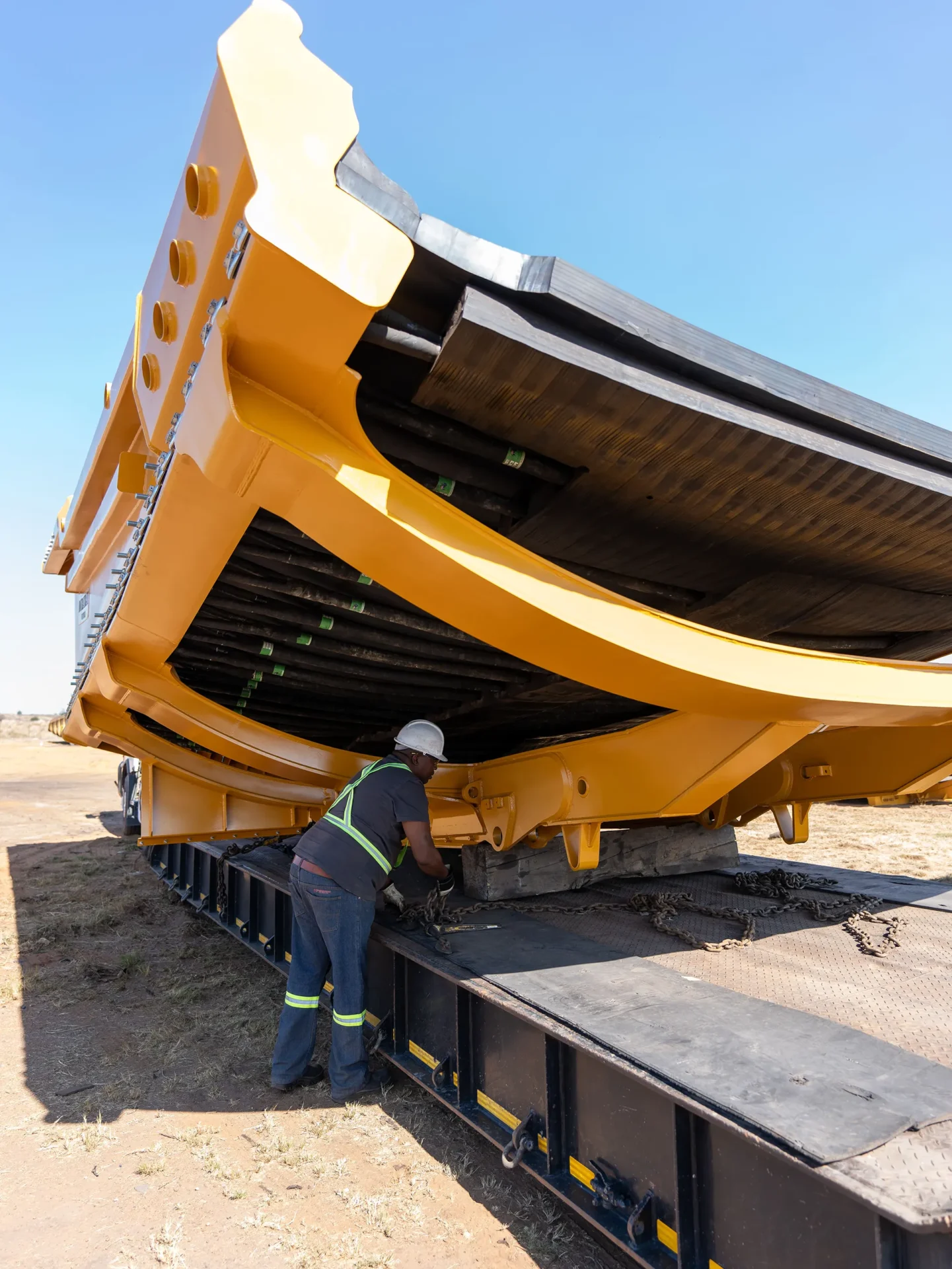
The Duratray Suspended Dump Body hangs a flexible rubber wear mat on high-capacity synthetic suspension ropes inside an abrasion-resistant steel frame. The ropes carry the payload in tension. The rubber absorbs the hit and dissipates energy as heat. The payload is decoupled from the rigid structure beneath it.
The parallel is direct. A tensioned, damped rope network catches impact loads that would shatter a rigid panel, whether the load is a fly or a boulder. Duratray calls the engineered system its Suspended Load Isolation System.
What It Means for Vibration, Noise and Carry-Back
When impact energy is absorbed at the floor, less of it reaches the people and components that suffer from it:
Operator health:
In Duratray’s Drayton trial, health-weighted whole-body vibration measured 0.611 m/s² for a steel body against 0.259 m/s² for the suspended dump body.
Noise:
In-cab noise fell from 92.3 to 86.8 dB(A) in the same reporting.
Maintenance:
Less energy cycling through welds and mounts means less fatigue cracking.
Carry-back:
A flexing floor helps shed sticky material, much as a hummingbird’s bending feathers shake off water.
These are Duratray-reported site trial figures, so be sure to request an on-site evaluation to assess your own operation.
Where the Analogy Stops
A web is a single-use catch that the spider repairs after each strike. A haul truck body takes impact thousands of times without a rebuild. The biology explains the physics of the design, not its durability, which is a question for engineering data.
Suspension also has to be tuned well, because any suspended system can amplify vibration near its natural frequency. The aim is reduced transmission and damped peaks, not zero vibration.
Frequently asked questions
It is a haul truck body whose floor is hung on suspension ropes instead of being rigidly bolted to the chassis. This isolates the chassis and operator from loading impact.
The floor stretches and flexes, which lengthens the stopping time, and the rubber and ropes dissipate impact energy as heat. Less energy passes into the chassis and cab.
Duratray reports lower carry-back because the flexible floor helps dislodge material. Results vary by material and site.
Catch the Hit, Then Let It Fade
Nature’s principle is simple: don’t fight impact. Absorb it, spread it and let it fade. The spider’s web is the original suspended load floor.
So is your tray built to resist every hit, or to catch it? Read the Duratray suspended dump body guide to see how it performs on site.
Recent News