Noticias
La compra de camiones mineros sin tolvas OEM: La guía de ingeniería para compras de combinación óptima
Abril 20, 2026
Resumen ejecutivo
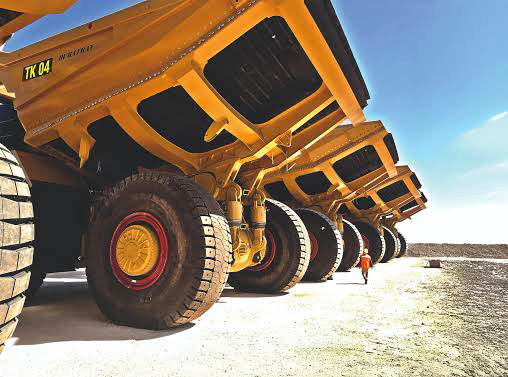
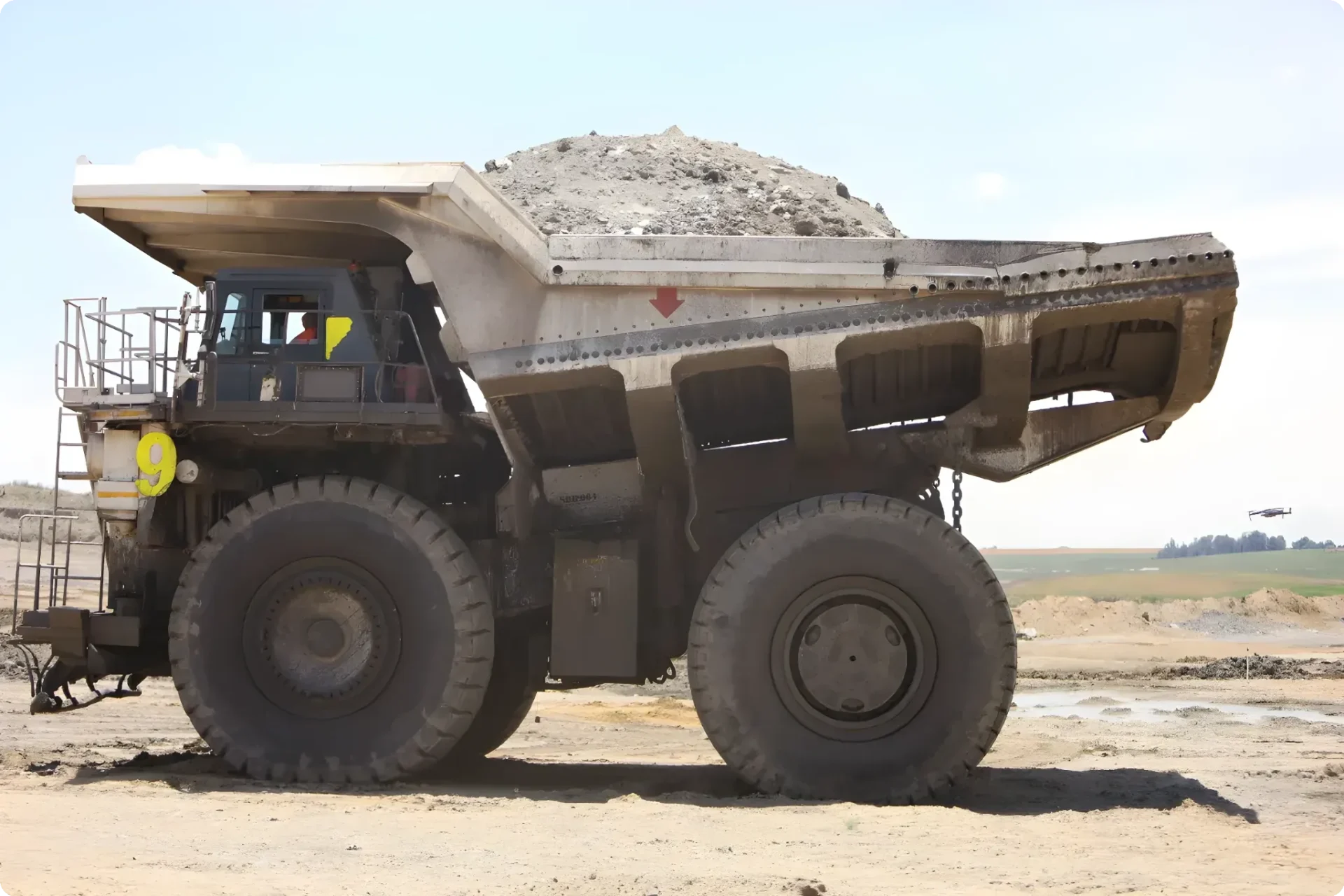
The global mining sector is currently navigating a period of profound structural transition, defined by deepening pits, declining ore grades, and the rapid integration of Autonomous Haulage Systems (AHS).1 In this environment, operational complexity demands absolute precision in asset procurement. The conventional methodology of acquiring heavy haulage equipment as a fully assembled, factory-standard unit is no longer structurally or financially viable. The strategic imperative for 2026 and beyond is focused on buying mining trucks without OEM trays to ensure an optimal combination purchase.
This engineering report outlines the technical and commercial rationale for decoupling the payload container from the host chassis at the point of capital expenditure:
The Elimination of Outdated Steel Trays:
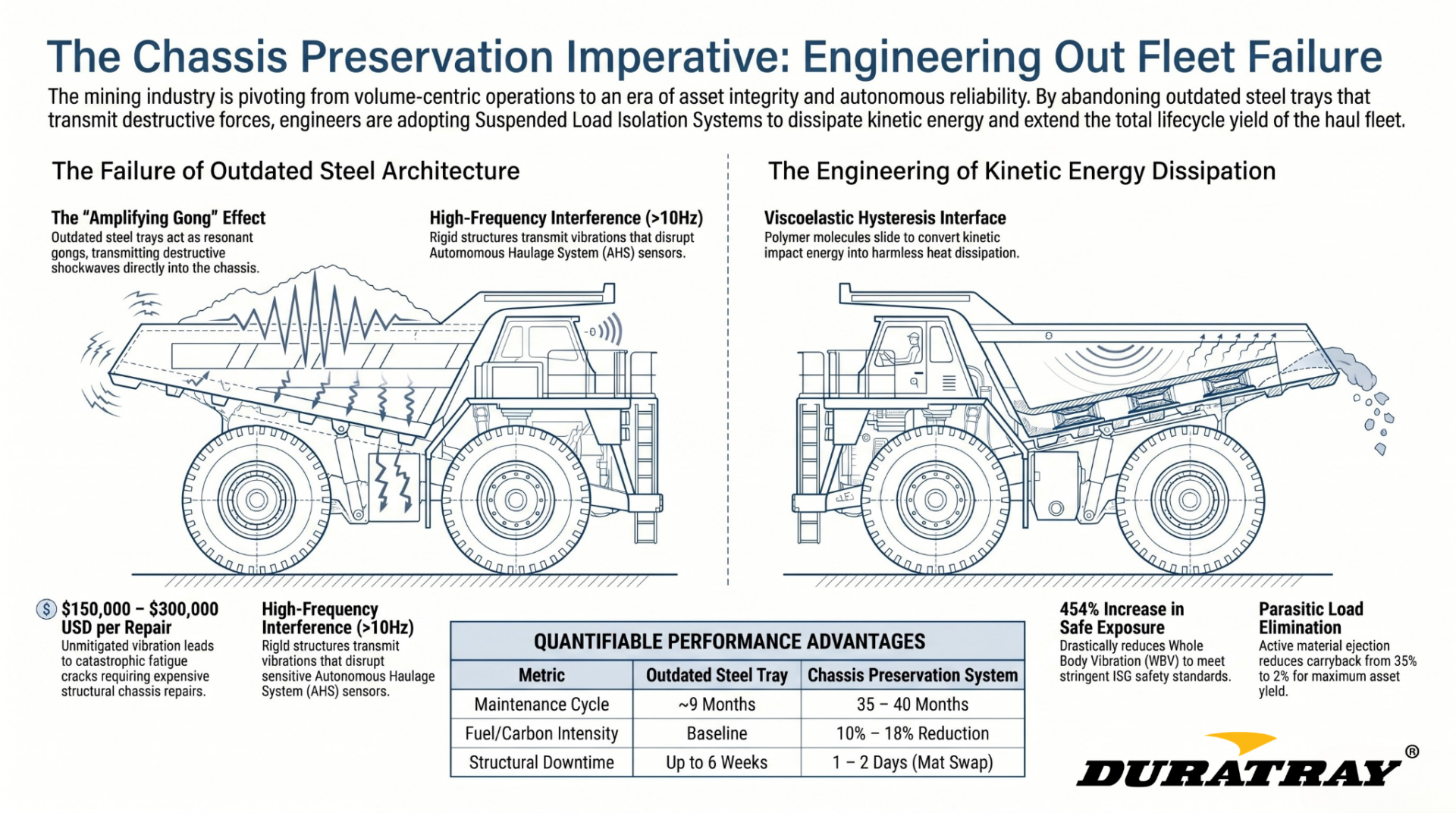
Factory-standard bodies act elastically, transmitting violent kinetic energy directly into the precision-engineered chassis. This “rigidity trap” accelerates structural fatigue and incurs massive repair costs.3
Implementation of THE Chassis Preservation System:
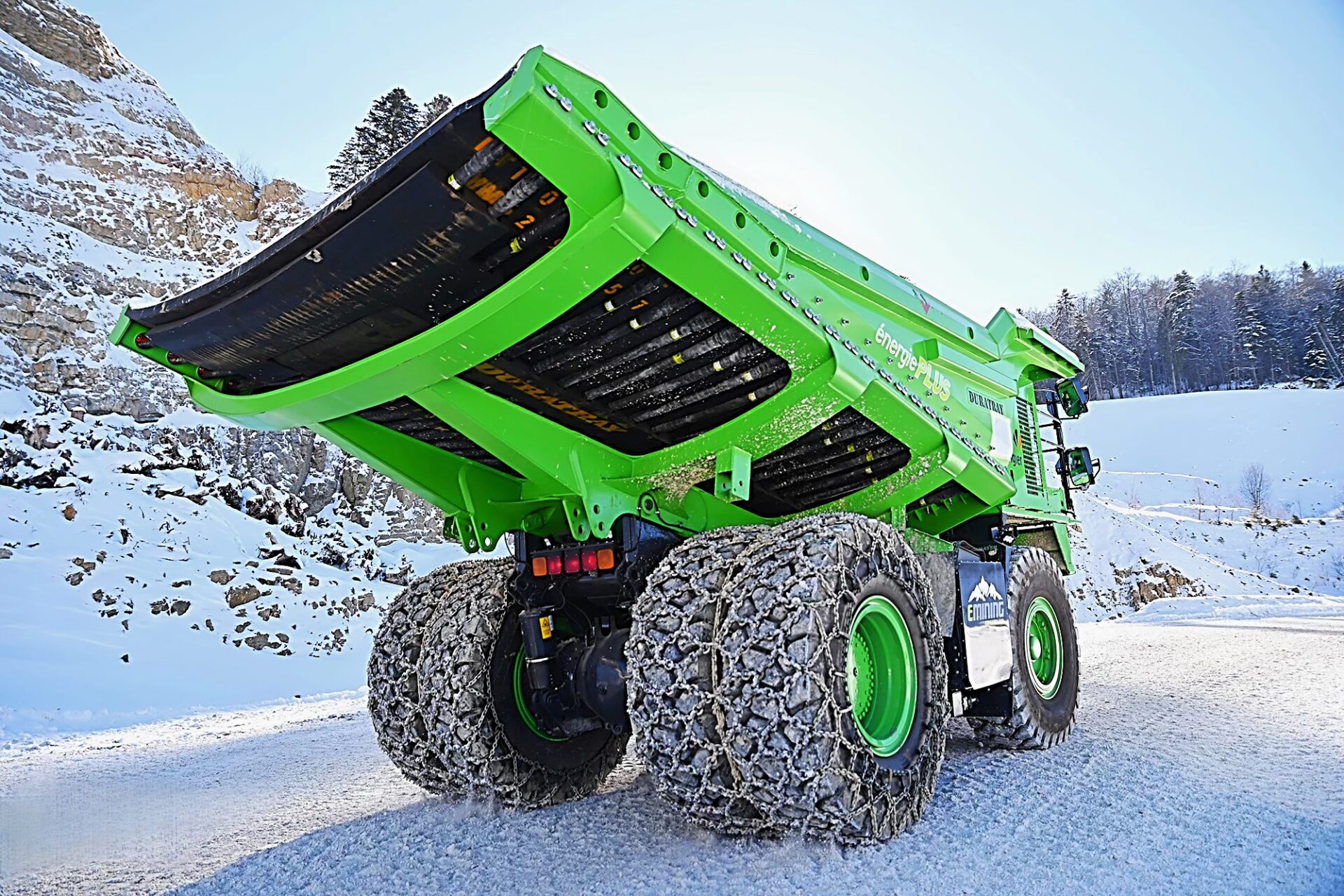
Procuring a bare chassis allows operations to immediately integrate a Suspended Load Isolation System. This Fatigue Mitigation Architecture physically decouples the payload from the truck frame.1
Advanced Kinetic Energy Dissipation:
Utilising a Viscoelastic Hysteresis Interface ensures that loading shock is actively converted to heat rather than structural vibration, achieving true Shock Event Isolation and Peak Force Truncation.1
Protection of Autonomous Investments:
AHS deployment requires stable environmental data. The new architecture provides vital Sensor Noise Floor Reduction via High-Frequency Vibration Decoupling, protecting fragile LiDAR and inertial sensors.1
Maximised Operator Safety:
For manned fleets, Bio-Mechanical Isolation extends operator safe exposure times by 454%, alongside critical Acoustic Power Attenuation.1
Unrivalled Financial Yield:
Buying mining trucks without OEM trays enables Parasitic Load Elimination and Active Material Ejection, cutting fuel and tyre costs by 18% while guaranteeing long-term Asset Lifecycle Extension.1
1.0 The Procurement Fallacy and the Optimal Combination Purchase
In the highly standardised environment of modern mining operations, physical dominance is frequently undermined by administrative algorithms. Enterprise Resource Planning (ERP) systems and risk-averse procurement matrices have created an “industrial filterworld” that actively flattens engineering diversity.5 These algorithmic procurement processes bias large, standardised supply chains, pushing site managers toward the frictionless, default choice: a standard rigid steel body bolted to a chassis at the factory.5
This algorithmic conformity represents a fundamental engineering miscalculation. A haul truck chassis is a highly sophisticated, multi-million-dollar precision asset. When procurement teams accept the default factory specification, they subject this asset to outdated steel trays that fight against the severe physics of the mine site. Standard bodies operate on a philosophy of brute force, acting as a bottleneck that throttles the potential of the entire haulage fleet.6
The strategic alternative is the optimal combination purchase. Buying mining trucks without OEM trays introduces necessary friction into the procurement process, disrupting groupthink and prioritising exact geological and operational suitability over database standardisation.5 By acquiring the prime mover as a standalone asset, engineering teams can specify and install THE Chassis Preservation System from day one. This proactive approach to CapEx acquisition permanently shifts the operational philosophy from a commoditised “payload-at-all-costs” mindset to genuine Asset Lifecycle Extension.1
1.1 The Hidden Tax of Rushed Purchase Decisions
In the current economic climate, where capital equipment costs are rising sharply, procurement teams often face immense pressure to operationalise fleets rapidly. This urgency frequently leads to rushed purchase decisions and reactive planning, where operators simply want a machine delivered without delay to hit short-term targets. However, these last-minute scrambles for standard off-the-shelf solutions consistently result in long-term budget overruns and severe operational inefficiencies.
Rushed initial cost estimates fixate entirely on the immediate capital expenditure (CapEx), attempting to secure a slightly lower upfront ticket price for a standard factory setup. By capitulating to these rushed procurement cycles, operations explicitly exclude consideration of the profound Total Cost of Ownership (TCO) benefits offered by THE Chassis Preservation System. Overlooking a Suspended Load Isolation System is a fundamental engineering misstep; any perceived initial saving from a rushed purchase is rapidly eclipsed by a decade of accelerated chassis fatigue, diminished payload yields, and compounding structural maintenance costs.4
2.0 The Physics of Loading and Shock Event Isolation
To fully grasp the critical importance of buying mining trucks without OEM trays, operations must analyse the thermodynamic and mechanical realities of loading a 400-tonne machine. When jagged, high-density hard rock is dropped from a shovel or excavator bucket, massive kinetic energy is generated. This energy must either be absorbed, stored, or dissipated.
2.1 The Rigidity Trap of Outdated Steel Trays
Conventional factory equipment, as well as aftermarket lightweight steel variants, suffer from inherent structural rigidity. Proponents of lightweight steel often cite a “flex fallacy,” arguing that thinner, high-tensile steel provides flexibility.3 In physics, however, steel flexes like a spring. It stores kinetic energy momentarily during the loading cycle and releases it as high-frequency vibration, transmitting a destructive shockwave directly through the vehicle’s structural mounts.3
This high-impact load acts as a continuous “anvil effect” on the host machine.2 The harmonic transmission is the primary causal factor for microscopic stress fractures that rapidly propagate into catastrophic chassis failures, leading to significant downtime and repair costs.3
2.2 Viscoelastic Hysteresis Interface
Conversely, THE Chassis Preservation System deploys a Viscoelastic Hysteresis Interface to fundamentally alter these loading physics.1 When site management commits to buying mining trucks without OEM trays, they unlock the ability to utilise elastomeric hysteresis. Unlike steel, which springs, or hybrid rubber-lined trays, which provide merely passive acoustic dampening, a viscoelastic architecture actively kills kinetic energy.1
The molecular friction within the impact media stretches to accommodate the rock drop, converting the violent kinetic energy into negligible heat.1 This continuous Kinetic Energy Dissipation ensures that the destructive force never rebounds or reaches the chassis.1 It is an active engineering function that achieves total Shock Event Isolation.1
2.3 Dynamic Catenary Suspension
This active attenuation is enhanced by the system’s underlying structure: the Dynamic Catenary Suspension. Rather than a rigid steel floor, the Viscoelastic Hysteresis Interface is suspended via high-tech ropes, replicating the specific physics of a rope-suspended curve.1 This completely decouples the load weight from the prime mover’s structural frame.
The resulting engineering benefit is Peak Force Truncation.1 The suspended system truncates the sharp spike of an impact load, aggressively smoothing the force curve passed to the truck frame.1
| Physical Dynamic | Outdated Steel Trays | THE Chassis Preservation System | Operational Consequence |
| Material Behaviour | Elastic / Spring-like | Viscoelastic Hysteresis | Converts kinetic energy to heat, neutralising structural shock. |
| Architectural Base | Rigid Steel Plate | Dynamic Catenary Suspension | Decouples payload mass from the host chassis. |
| Force Management | Shock Transmission | Kinetic Energy Dissipation | Eliminates the anvil effect, resulting in Shock Event Isolation. |
| Impact Signature | High-Frequency Spike | Peak Force Truncation | Smooths the dynamic force curve, actively preventing steel fatigue. |
3.0 Commercial Viability and Asset Lifecycle Extension
The financial justification for buying mining trucks without OEM trays is grounded entirely in Total Cost of Ownership (TCO) and long-term asset yield. In capital allocation meetings, the slightly lower initial ticket price of a conventional steel body can appear seductive.4 However, mining equipment is purchased to generate revenue over decades, not to hit a quarterly procurement target. The critical metric is the total cost per tonne moved over the asset’s lifespan.
3.1 Eliminating the Financial Burden of Chassis Fatigue
Chassis fatigue acts as a compounding operational tax. The relentless transmission of kinetic shockwaves from outdated steel trays rapidly accelerates the degradation of the truck’s skeletal structure.1 Repairing a cracked haul truck frame requires complex, highly specialised welding, which is becoming increasingly difficult to source due to a severe global maintenance skills shortage.3 Individual chassis repairs routinely cost operations between $150,000 and $300,000.1 This figure excludes the catastrophic opportunity cost of removing a primary production asset from the haul cycle for weeks.
When operations pursue the optimal combination purchase, they implement true Fatigue Mitigation Architecture. Independent studies document a massive 40% to 52% reduction in G-forces experienced by the host equipment when using suspended systems.4 This dramatic reduction in dynamic stress loads ensures Modular Asset Sustainment. Because the Viscoelastic Hysteresis Interface absorbs the wear, structural maintenance cycles stretch to 35–40 months, compared to the standard 9-month intervals required for rigid OEM bodies.1 When maintenance is required, it involves a simple 1–2 day component exchange rather than extensive hot work.1
3.2 Optimised Sprung Mass and Payload Yield
Buying mining trucks without OEM trays allows for the integration of a lightweight Structural Space Frame.1 Outdated steel trays are heavy, monolithic structures that consume a large percentage of the vehicle’s Gross Vehicle Weight (GVW). A suspended system delivers an Optimised Sprung Mass, achieving a 10% to 20% reduction in tare weight compared to standard alternatives.1 This weight saving translates directly into a 20% payload increase per cycle, significantly elevating the dynamic yield of the operation without exceeding OEM chassis limits.1
The longevity of this architecture is well documented. In highly abrasive hard rock environments such as the Argyle Diamond Mine, and extreme arctic conditions at Diavik and Ekati, these suspended systems have recorded continuous service lives of 18 to over 20 years.4
4.0 The Autonomous Haulage Imperative
The contemporary mining landscape is defined by the rapid deployment of Autonomous Haulage Systems (AHS) and advanced operational edge control.1 While major equipment manufacturers sell highly intelligent software ecosystems, these fragile robotic systems are frequently handicapped by being bolted to rigid hardware.3
4.1 Shielding Fragile Hardware
Autonomous navigation relies on a delicate suite of LiDAR arrays, radar units, and Inertial Measurement Units (IMU). These sensors are acutely sensitive to mechanical interference. Outdated steel trays act as acoustic and kinetic amplifiers, transmitting high-frequency vibration (>10Hz) directly into the sensor mounts.1 This mechanical noise creates a chaotic data environment, generating false positives and forcing the AHS algorithms to automatically downgrade the truck’s speed to compensate for data instability.1
4.2 Sensor Noise Floor Reduction
For brownfield autonomy retrofits and greenfield AHS deployments alike, buying mining trucks without OEM trays is an absolute necessity. THE Chassis Preservation System functions as a physical firewall for the autonomous brain.1
The system achieves High-Frequency Vibration Decoupling, filtering out the specific resonant frequencies that degrade digital integrity.1 By delivering proven Sensor Noise Floor Reduction, this optimal combination purchase ensures the truck’s digital ecosystem receives clean, reliable telemetry. Operations benefit from fewer sensor faults, reduced human intervention requirements, and higher sustained average tramming speeds, ensuring the multi-million-dollar autonomous investment delivers its promised ROI.1
5.0 Bio-Mechanical Isolation and ISO Compliance
Despite the rise of autonomy, manned haulage fleets remain the backbone of the global mining industry. The human operator is both the most valuable and the most fragile component in the loading cycle. Subjecting operators to the violent impacts associated with rigid steel bodies results in severe Whole Body Vibration (WBV), causing immediate cognitive fatigue and long-term spinal degradation.1
5.1 Beyond Driver Comfort
Historically, the industry has relied on the truck’s cabin suspension to manage “driver comfort.” However, comfort is a subjective metric; biological protection is objective and regulated.1 Buying mining trucks without OEM trays allows occupational health and safety teams to enforce clinical safety limits through Bio-Mechanical Isolation.1
Because the Dynamic Catenary Suspension actively isolates the load, vibration transmission is reduced by up to 50%.1 This reduction directly addresses global standards for Whole Body Vibration, elevating the haul truck into full ISO 2631 Compliance.1 The quantitative result is an unprecedented 454% increase in the operator’s Extended Safe Exposure Time—lowering vibration exposure from a hazardous 0.611 m/sec² to a safe 0.259 m/sec².1
5.2 Acoustic Power Attenuation
Alongside kinetic impact, acoustic trauma presents a significant operational hazard. Outdated steel trays generate immense acoustic reflection during loading.1 The Viscoelastic Hysteresis Interface provides scientifically validated Acoustic Power Attenuation. In-cab noise is reduced by 5.5 dB(A) (from 92.3 to 86.8 dB(A)), representing a logarithmic decrease in sound energy that drastically reduces operator fatigue.1 Furthermore, external noise emissions are reduced by up to 14 dB.1 For operations situated near populated areas or operating under stringent European or ESG noise compliance mandates, this noise reduction serves as a vital tool to secure and maintain their social license to operate.1
| Human Factor Metric | Outdated Steel Trays | THE Chassis Preservation System | Resulting Operational Impact |
| Vibration Exposure | Unmitigated Baseline | Reduced by 50% | Prevents long-term spinal degradation. |
| Safe Operating Time | Limited by fatigue limits | 454% Extension | Achieves strict ISO 2631 Compliance. |
| Internal Acoustics | 92.3 dB(A) | 86.8 dB(A) | Lowers cognitive fatigue via -5.5 dB attenuation. |
| External Acoustics | High Decibel Output | Reduced by up to 14 dB | Ensures strict ESG and environmental mandate compliance. |
6.0 Active Material Ejection and the Eradication of Parasitic Loads
The operational complexity identified by leading industry analysts highlights the urgent need to control costs and eliminate systemic waste.2 One of the most insidious forms of waste in the mining cycle is carryback—the accumulation of sticky laterite, wet clay, or cohesive ore inside the dump body.1
6.1 The Parasitic Tax of Rigid Geometry
Outdated steel trays are designed with rigid 90-degree corners and deep structural ribbing. These geometric features create a vacuum seal with wet material, preventing it from leaving the tray during the dump cycle.2 Operations frequently experience material retention rates of up to 35%.1
Carryback is not merely an inconvenience; it is a profound operational drain. A truck carrying 20 tonnes of retained dirt on its return journey is burning diesel and wearing down its tyres to transport zero revenue-generating payload.6 This dynamic severely degrades Payload Management (PLM) accuracy and bloats the operation’s carbon footprint.1
6.2 Kinetic Shedding and Parasitic Load Elimination
Buying mining trucks without OEM trays fundamentally solves this issue. The optimal combination purchase leverages the flexible nature of the Dynamic Catenary Suspension to facilitate Active Material Ejection.1 As the hoist cylinders raise the chassis, the suspended Viscoelastic Hysteresis Interface alters its shape. This kinetic movement actively breaks the cohesive vacuum seal of the sticky ore, physically ejecting the material from the tray.1
This process results in total Parasitic Load Elimination. Operations report that carryback is reliably minimised to just 3%, ensuring that every drop of fuel is utilised for productive haulage.1
6.3 Decarbonisation and Tangible OpEx Savings
The compounding effect of removing parasitic weight, combined with the Optimised Sprung Mass of the space frame, yields massive operational expenditure (OpEx) reductions. Documented field data confirms that operations achieve up to 18% savings in fuel consumption and tyre wear.1 For a medium-sized fleet of twenty trucks, these efficiencies can easily exceed one million litres of diesel saved annually.4 In an era where mining enterprises are heavily scrutinised for Scope 3 emissions and carbon intensity, the ability to radically lower fuel burn per tonne moved is a paramount strategic advantage.1
7.0 The Imperative for 2026 Procurement
The global mining ecosystem cannot afford to remain trapped within an algorithmic filterworld.5 The reliance on standardisation and the passive acceptance of outdated steel trays represents a critical vulnerability in the face of declining ore grades and rising operational complexity.2
The engineering data is irrefutable. Buying mining trucks without OEM trays is the optimal acquisition strategy for the modern mine. By taking delivery of a prime mover and independently specifying THE Chassis Preservation System, operations achieve a superior combination purchase that protects capital expenditure and maximises asset yield.
Through the physics of Viscoelastic Hysteresis, Dynamic Catenary Suspension, and active Shock Event Isolation, mining companies can abandon the commoditised “payload-at-all-costs” philosophy in favour of genuine Asset Lifecycle Extension. This Fatigue Mitigation Architecture is not merely an alternative container; it is the physical firewall necessary to protect autonomous sensors, ensure operator ISO compliance, eradicate parasitic loads, and secure the operational future of multi-million-dollar haul fleets. In 2026, the optimal combination purchase is the only engineered path forward.
Works cited
Duratray Suspended Dump Body: Aligned with Mining’s 2026 Priorities | Operational Complexity & Productivity, accessed on April 19, 2026, https://duratray.com/duratray-suspended-dump-body-mining-2026-priorities/
The Challenge is on. The Suspended Dump Body vs Steel: Why Your Mine is Losing Millions | Duratray, accessed on April 19, 2026, https://duratray.com/why-your-mine-is-losing-millions/
The Industrial Filterworld: Step 1 – Escaping the Algorithm of Engineering Groupthink, accessed on April 19, 2026, https://duratray.com/industrial-filterworld-engineering-groupthink/
The Tray is Everything: The Ultimate Strategic Guide to Operational Optimisation Mining, accessed on April 19, 2026, https://duratray.com/operational-optimisation-mining-suspended-dump-body/
Duratray International: A Truly Unique Force in the Mining Industry – Valued by discerning mines, accessed on April 19, 2026, https://duratray.com/duratray-international-a-truly-unique-force-in-the-mining-industry/
Ten major mining tech trends in 2026: Part 1, accessed on April 19, 2026, https://imarcglobal.com/news/industry/ten-major-mining-tech-trends-in-2026-part-1
Noticias recientes