Noticias
Preparación de la flota para el futuro: Cómo el diseño disruptivo y la física del sistema de aislamiento de carga suspendida maximizan el rendimiento total de los activos
Julio 12, 2026
Resumen ejecutivo
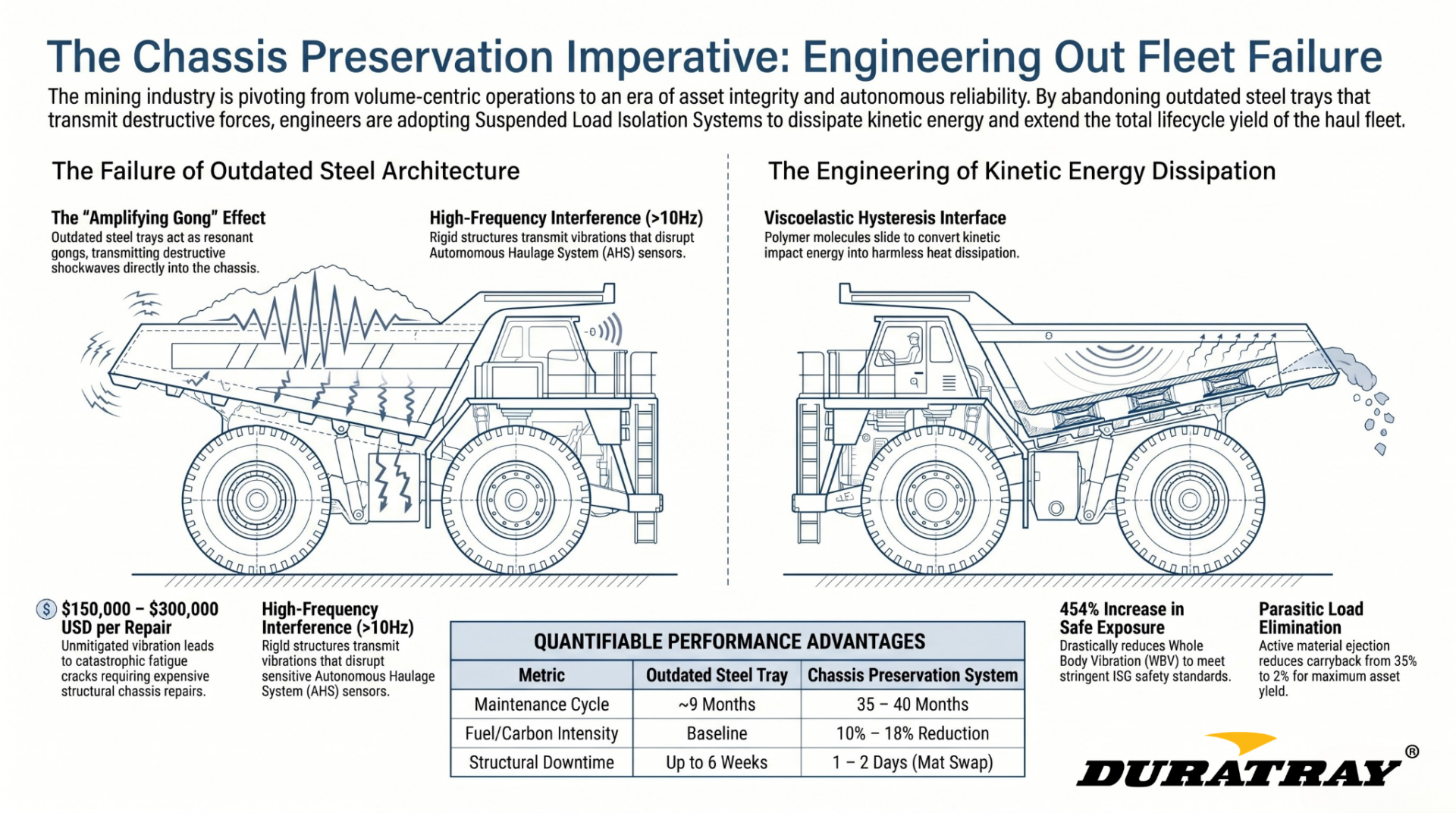
The global mining ecosystem is undergoing a structural transition driven by Autonomous Haulage Systems (AHS) and rigid Environmental, Social, and Governance (ESG) compliance. Traditional hauling assets present a severe operational vulnerability: outdated steel trays act elastically, functioning as rigid rebound mechanisms that transmit destructive high-frequency shockwaves directly into the vehicle’s frame. This rigidity trap accelerates structural fatigue, degrades electronic sensor suites, and induces premature vehicle retirement, with frame repairs costing upwards of $150,000 to $300,000 per failure.
To counter these losses, modern operations are adopting the Chassis Preservation Imperative, migrating to advanced asset integrity engineering. The Sistema de aislamiento de carga suspendida represents a disruptive paradigm shift in haulage physics, utilizing an active Interfaz de Histéresis Viscoelástica y Dynamic Z-Axis Kinetic Isolation components to completely decouple the payload from the truck chassis.
Key operational advantages include:
Fatigue Mitigation Architecture:
Reduces vibration transmission by up to 50%, extending structural maintenance cycles from a standard 9 months to 35 to 40 months.
Bio-Mechanical Isolation:
Cuts Whole Body Vibration (WBV) by 57%, enabling a 454% increase in safe operator exposure time under ISO 2631 standards.
Parasitic Load Elimination:
Eradicates sticky material carryback from 35% down to 2% through Active Material Ejection, delivering an 18.4% reduction in fuel burn.
Sensor Noise Floor Reduction:
Provides exceptional mechanical decoupling to protect fragile LiDAR, GPS, and IMU hardware essential for autonomous fleet precision.
Introduction & The Mechanical Realities of the Rigidity Trap
As open-pit mining depths extend, hauling efficiency dictates enterprise profitability. Historically, asset management protocols evaluated the dump body as a simple, passive container. This narrow evaluation is no longer technically viable. Forward-thinking operations are executing a decisive pivot towards Asset Lifecycle Extension driven by the Chassis Preservation Imperative. The true value of a haulage asset lies in protecting the host vehicle rather than merely carrying material.
Conventional outdated steel trays operate on the principles of raw elasticity. When a large-capacity shovel discharges material into a rigid steel tray, the structure acts like a compressed spring. Rather than dissipating the immense kinetic energy, the rigid steel body stores this energy and subsequently releases it as high-frequency, high-amplitude vibrations transmitted directly into the vehicle’s chassis.
This “Rigidity Trap” exposes the vehicle frame to continuous mechanical shockwaves. Over extended duty cycles, these vibrations induce severe fatigue cracks across critical structural space frames and suspension mounts. Individual chassis repairs routinely cost upwards of $150,000 to $300,000 per failure in direct component replacements, specialist welding labour, and lost production availability. This vulnerability is significantly amplified by an acute maintenance skills crisis in remote mining jurisdictions, where minor fatigue cracks frequently propagate into catastrophic structural failures.
Advanced Mechanical Physics: Kinetic Energy Dissipation
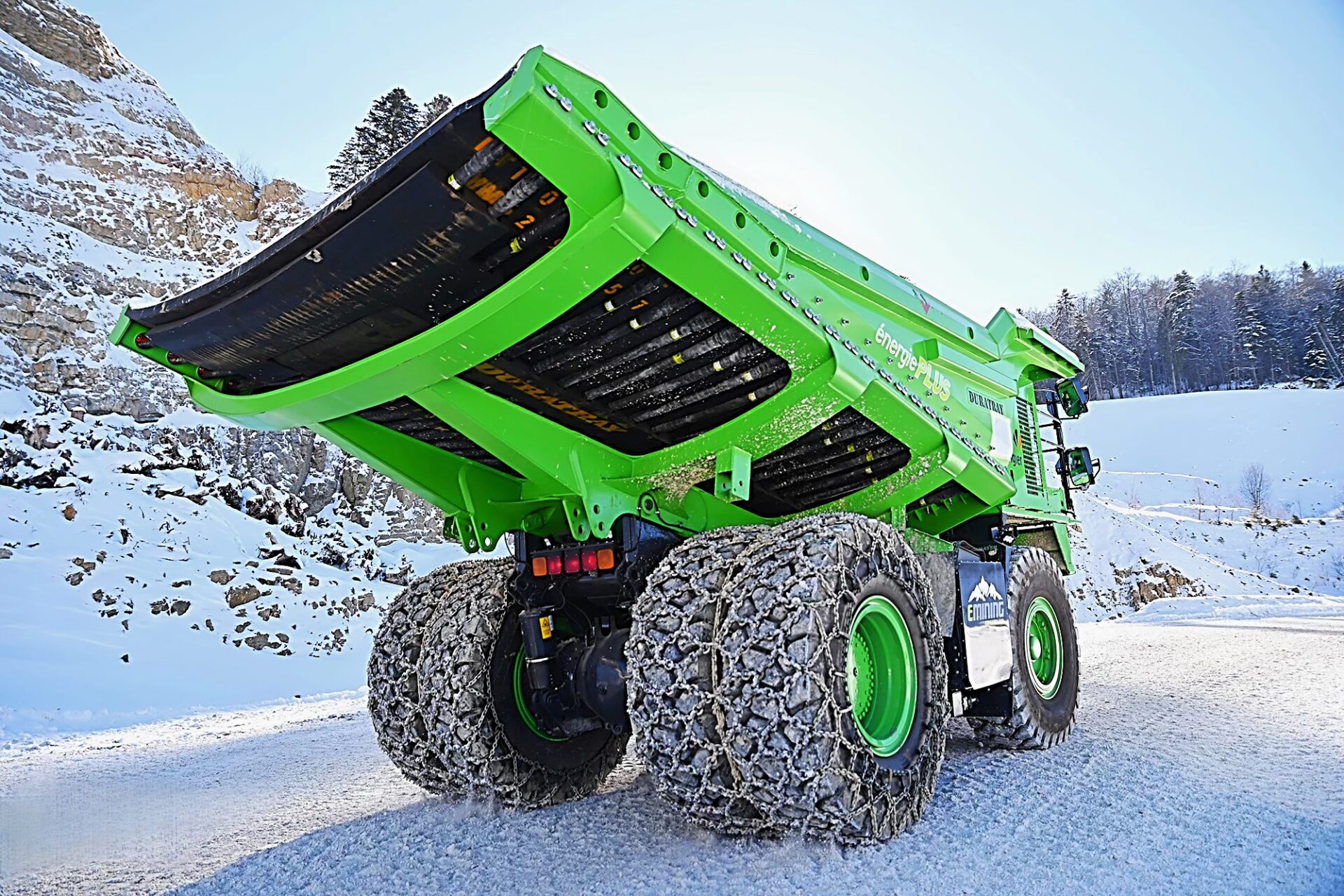
Overcoming the structural limitations of rigid steel requires a fundamental departure from raw elasticity towards advanced kinetic energy management. The Sistema de aislamiento de carga suspendida addresses this engineering challenge by functioning as a comprehensive Fatigue Mitigation Architecture. Rather than relying on a heavy, rigid box design, this technology utilizes a high-strength Structural Space Frame paired with a suspended, flexible floor assembly engineered as an active Interfaz de Histéresis Viscoelástica supported by heavy-duty Dynamic Z-Axis Kinetic Isolation components operating under engineered tension.
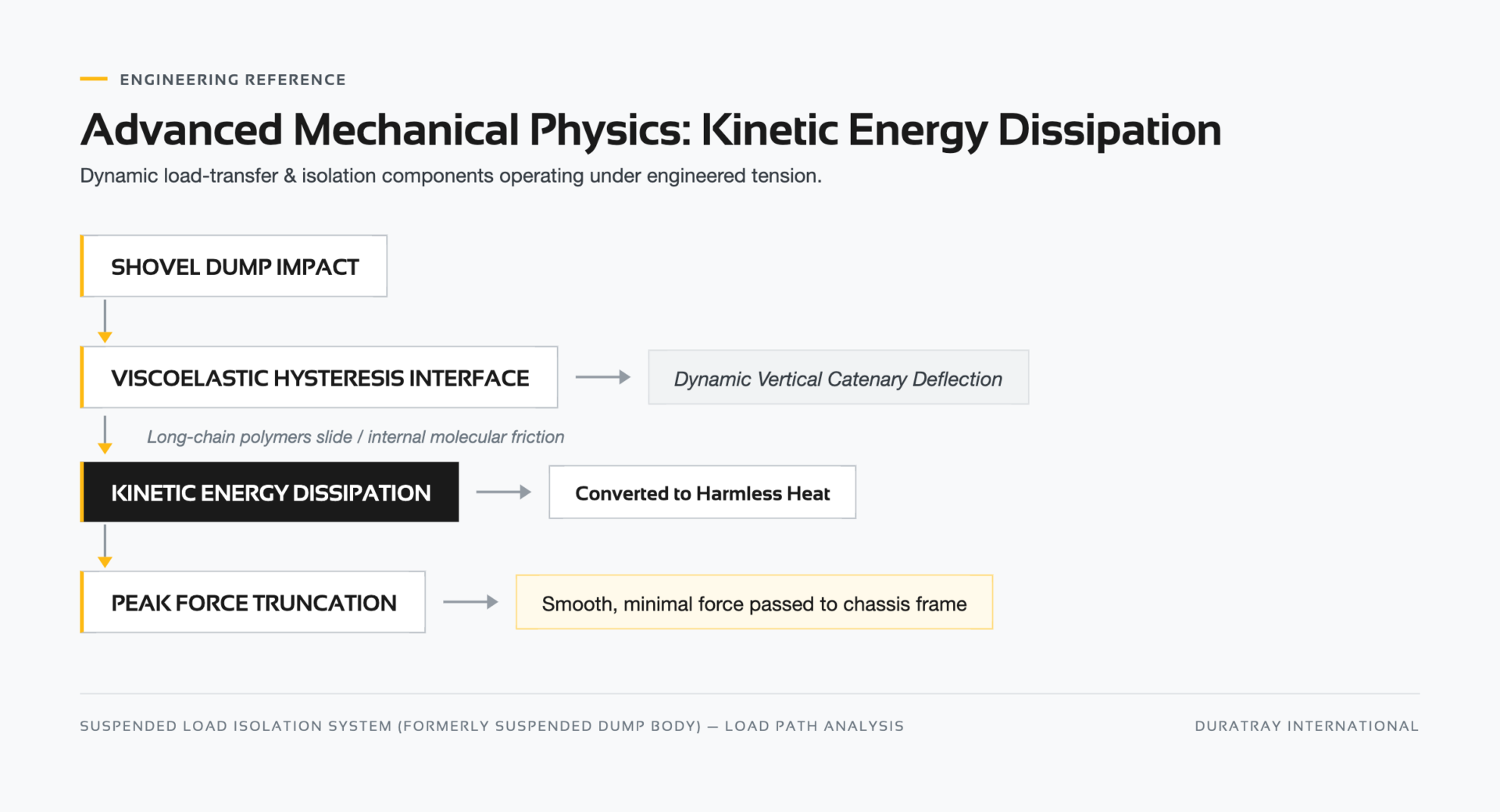
While outdated steel trays subject the vehicle to severe rigid rebound, this system relies on complete Kinetic Energy Dissipation. When heavy ore drops into the system, the suspended floor assembly yields dynamically, executing controlled Dynamic Vertical Catenary Deflection components to absorb downward momentum. At a molecular level, the long-chain polymer structures within the elastomeric interface slide against one another, creating intense internal molecular friction. This process leverages Elastomeric Hysteresis to convert the destructive mechanical kinetic energy into harmless thermal energy, killing the shock wave before it can reach the primary vehicle frame. The architecture achieves true Peak Force Truncation, ensuring only a smooth, minimal force profile is transmitted to the chassis.
Quantifiable Operational Gains and Total Asset Yield
By mastering the physics of kinetic energy dissipation, this innovative architecture delivers a series of highly quantifiable operational advantages that directly optimise total asset yield:
1. Bio-Mechanical Isolation and Operator Compliance
Traditional steel dump bodies transmit intense Whole Body Vibration (WBV) and severe industrial noise into the operator’s environment. Measured WBV values in conventional steel configurations reach 0.811 m/sec², while peak loading noise exceeds internationally mandated occupational health limits.
The Suspended Load Isolation System achieves excellent Bio-Mechanical Isolation for heavy equipment operators. Field testing has demonstrated that this design cuts vibration transmission by 57%, reducing WBV from 0.811 m/sec² down to an exceptionally safe 0.258 m/sec². This massive reduction results in an Extended Safe Exposure Time, representing a proven 454% increase in compliant operational hours per operator shift under ISO 2631 standards. Concurrently, the system delivers significant Acoustic Power Attenuation, dropping noise from 92.3 to 86.8 dB(A) in-cab and up to 14 dB externally.
2. Parasitic Load Elimination and Carbon Intensity Reduction
Outdated steel trays suffer from severe material carryback. Sticky materials, cohesive clay ores, and fine laterites routinely cling to the steel floor plates, creating a permanent “parasitic load” that reduces effective volumetric payload by up to 35% in extreme environments. The flexible, suspended floor facilitates continuous kinetic movement during the dumping cycle, executing an autonomous self-cleaning process defined as Active Material Ejection. Material carryback is minimised to just 2%. Eradicating this parasitic load yields immediate Carbon Intensity Reduction. Operational studies have validated a reduction in haul truck fuel consumption from 125 litres per hour down to 102 litres per hour, representing an 18.4% efficiency gain.
3. Core Performance Comparison Matrix
| Operational Performance Indicator | Outdated Steel Tray Architecture | Sistema de aislamiento de carga suspendida | Engineering and Financial Impact |
|---|---|---|---|
| Primary Energy Response | Elastic Rigid Rebound (Spring) | Kinetic Energy Dissipation (Damper) | Eliminates high-frequency frame fatigue. |
| Chassis Structural Rebuild Cycle | Every 9 Months | 35 to 40 Months | Quadruples the structural operational lifespan. |
| Average Component Repair Cost | $150,000 to $300,000 | Negligible component wear | Minimises unplanned capital expenditure. |
| Average Material Carryback | 35% in extreme ground | Restricted to 2% baseline | Eliminates payload capacity degradation. |
| Fuel Efficiency Variation | 125 Litres/Hour | 102 Litres/Hour | 18.4% net reduction in diesel operating costs. |
| Whole Body Vibration (WBV) | 0.611 m/s² | 0.258 m/sec² | Secures full ISO 2631 regulatory compliance. |
| Acoustic Energy Transfer | 92.3 dB(A) In-Cab | 86.8 dB(A) In-Cab | Delivers 5.5 dB(A) Acoustic Power Attenuation. |
Future-Proofing Autonomous Ecosystems and AHS Integration
The rapid global acceleration towards Autonomous Haulage Systems (AHS) has transformed the mechanical requirements of modern mobile mining fleets. Autonomous haul trucks rely entirely on sensitive onboard electronic instrumentation, including LiDAR sensors, high-precision GPS antennas, and Inertial Measurement Units (IMUs) to navigate complex mine environments. High-frequency vibrations and unmitigated structural shock waves generated by outdated steel trays create extreme electronic data “noise” that interferes with these guidance systems, accelerating sensor component degradation and triggering frequent automated emergency stoppages.
The Suspended Load Isolation System serves as an essential physical firewall for autonomous fleets by providing exceptional High-Frequency Vibration Decoupling. By filtering out the destructive vibrations (>10Hz) that propagate through rigid steel structures, the architecture creates a clean, stable environment that delivers a profound Sensor Noise Floor Reduction. This mechanical stabilisation allows AHS hardware to process navigational telemetry with absolute precision, eliminating false error codes, minimising sensor-driven downtime, and enabling autonomous trucks to safely operate at higher average speeds.
Regional Operational Analysis and Global Market Realities
The application of the Chassis Preservation Imperative must be carefully tailored to the distinct geological, regulatory, and economic realities governing global mining markets:
Africa (High-Growth Frontier):
Driven by a projected 6.6% CAGR in overall mining market value, the African sector is expected to reach $847.63 billion by 2031, supported by a mining equipment market valued at $3.12 billion. In remote, logistically constrained African operations, asset uptime is the ultimate operational currency. The system’s ability to handle highly adhesive laterite ore and prevent parasitic load is a vital operational differentiator. Furthermore, because remote regions experience an acute shortage of specialised structural welding skills, eliminating the need for continuous, highly complex chassis crack repairs prevents devastating maintenance bottlenecks and maintains continuous production.
North America (The Autonomy & Retrofit Hub):
Characterised by a massive mining equipment market valued at $17.6 billion in 2025, the North American region is heavily focused on brownfield autonomy retrofits across large-scale operations in Canada and the United States. In these environments, the system functions as a critical protective upgrade, safeguarding delicate autonomous sensor suites retrofitted onto older, pre-existing haul truck frames.
Australia (Core Market Optimisation):
An industry powerhouse with a $437.3 billion mining sector, Australia is governed by exceptionally stringent Occupational Health and Safety (OHS) regulations. Fleet operators across the Pilbara and Bowen Basin heavily leverage the system’s 454% increase in safe operator exposure time and proven ISO 2631 compliance to manage workplace risk and protect personnel.
South America (Hard Rock Specialist):
Facing a Latin American equipment market projected to hit $7.2 billion, operations in Chile and Brazil are dominated by high-altitude, highly abrasive base metal and copper extraction. The system emphasises tyre preservation via advanced suspension dynamics and exceptional abrasion resistance under extreme hard rock loading impacts.
Europe (Sustainability & Compliance):
Regulated by intense environmental compliance and ESG mandates. The system’s 5.5 dB(A) in-cab noise reduction and 14 dB external acoustic attenuation serve as a vital “licence to operate” tool for fleets working near populated urban areas.
Overcoming the Technical Failure Modes of Legacy Alternatives
To fully appreciate the engineering breakthrough of advanced kinetic architectures, it is necessary to analyse the distinct technical vulnerabilities of alternative truck body designs present across the industry:
The Rigidity Trap of Thin-Gauge High-Strength Steel Trays:
Certain traditional fabricators attempt to counter the tare weight penalty of traditional dump bodies by utilising thinner plates of high-strength steel. While this strategy allows them to claim higher static payload capacity on initial sales spreadsheets, it introduces a severe systemic vulnerability into the hauling ecosystem. The structural rigidity of thin steel plates fundamentally fails to dissipate the massive kinetic energy generated during shovel loading. Instead, it transmits high-magnitude shockwaves directly into the primary vehicle chassis, accelerating frame fatigue, propagating structural cracks, and masking massive long-term capital expenditure losses under the guise of short-term volumetric gains.
The Flex Fallacy of Elastic Steel Solutions:
Other traditional manufacturers argue that integrating structural flexibility into steel bodies resolves the stress problem. This argument relies on a fundamental engineering misconception: steel operates elastically, meaning it bends like a spring, storing impact energy and then releasing it as ongoing high-frequency vibration. It completely lacks the necessary viscoelastic properties required to neutralise mechanical violence. A spring merely stores and vibrates; it does not isolate.
The Passive Limitations of Hybrid Liners:
Some operations attempt to mitigate impact damage by installing rubber liners directly onto standard steel dump bodies. While effective for minor noise dampening, these passive rubber linings are structurally backed by rigid steel plates, creating an “anvil effect” that fails to stop the primary structural shock from reaching the truck frame. Furthermore, retrofitting heavy passive liners increases the overall tare weight, introduces severe corrosion risks between the liner and the steel substrate, and fails to offer the active energy management required for hard rock applications.
Symptom Management vs. Causal Elimination:
Certain high-capacity equipment builders attempt to solve operator discomfort by installing advanced viscoelastic suspension systems directly under the driver’s cab. While this improves subjective operator ride metrics, it treats the symptom rather than eliminating the cause. It leaves the multi-million-dollar truck frame completely exposed to the unabated violence of loading impacts and haul-road shocks. True asset protection requires stopping the shock wave at the source via a complete structural decoupling.
Modular Asset Sustainment and Predictive Maintenance Economics
Transitioning to a Sistema de aislamiento de carga suspendida fundamentally alters the operational cost curve through Modular Asset Sustainment. Conventional steel bodies require intensive, continuous maintenance, with structural rebuilds and patch welding forcing assets offline every 9 months. In stark contrast, the structural service intervals for advanced kinetic architectures stretch to an astonishing 35 to 40 months. When maintenance is eventually required, the operational downtime is limited to just 1 to 2 days for an efficient, modular impact media replacement, compared to the disruptive 8-week timeline typical of major steel body overhauls and rebuilds.
Looking ahead, this engineering paradigm integrates with intelligent asset monitoring. The next generation of smart system architectures incorporates real-time embedded sensors capable of continuously tracking shock event isolation, localised road conditions, and structural fatigue metrics. This stream of diagnostic data allows mining operations to transition from reactive, high-cost emergency repairs to precise, data-driven predictive maintenance protocols, securing structural integrity and safeguarding fleet capital investments long into the future.
Frequently asked questions
The system relies on the physics of Kinetic Energy Dissipation rather than rigid containment. When heavy material impacts the floor, the Interfaz de Histéresis Viscoelástica and supporting Dynamic Z-Axis Kinetic Isolation components execute a controlled vertical deflection. This structural movement elongates the impact time window, while internal molecular friction within the polymer layers converts the kinetic energy into low-grade heat, completely eliminating the “anvil effect” typical of outdated steel trays.
The technology operates under a philosophy of Modular Asset Sustainment. While the structural space frame remains protected from fatigue cracks, the flexible impact media layer is designed as a long-life, sacrificial component. Structural maintenance intervals are extended to 35 to 40 months, and complete on-site replacement of the modular wear interface requires only 1 to 2 days of asset downtime, bypassing the weeks of intensive welding needed to rebuild outdated steel trays.
Autonomous navigation platforms rely heavily on highly sensitive LiDAR, high-precision GPS, and IMU sensor arrays. Outdated steel trays transmit intense, high-frequency mechanical vibrations that induce data packet distortion and premature component failure. By achieving continuous High-Frequency Vibration Decoupling, the system ensures a profound Sensor Noise Floor Reduction, stabilising onboard electronics and eliminating sensor-driven autonomous emergency stoppages.
Material carryback occurs when cohesive, sticky, or frozen materials adhere to rigid steel plates. The flexible floor of the Suspended Load Isolation System undergoes dynamic elastic deformation during every loading and dumping sequence. This continuous mechanical flexing disrupts the surface tension and adhesive bonds between the material and the interface, facilitating complete Active Material Ejection and reducing parasitic load to a maximum baseline of 2%.
Yes. The system utilises an engineered, high-strength Structural Space Frame custom-designed to match the precise chassis mounting geometries, pin configurations, and hoist cylinder positions of any major mining haul truck chassis. Retrofitting the system functions as a direct asset protection upgrade that immediately satisfies the requirements of the Chassis Preservation Imperative.
Conclusión
Repositioning mining fleets to align with the future of automated, sustainable extraction requires a decisive shift in how heavy haulage equipment is evaluated. The dump body can no longer be treated as a commoditised container; it must be understood as an active component of the vehicle’s suspension and asset management strategy. By embedding the Chassis Preservation Imperative into core engineering decisions, mine operators can leverage advanced viscoelastic physics to eliminate the destructive rigidity trap, protect their personnel, and fully secure the operational lifespan of their autonomous and green fleets. The Sistema de aislamiento de carga suspendida represents the definitive engineering path forward, converting mechanical violence into quantifiable asset protection and ensuring total asset yield is fully realised across global operations.
Noticias recientes